After a stroke, many people ask a simple question:
“If I move more, will I recover more?”
Movement is important. Practice is important. But my research suggests that another question may be just as important:
“What kind of movement am I practicing?”
Not all movements mean the same thing.
After stroke, some movements happen as a group. For example, when a person tries to lift the arm, the shoulder, elbow, wrist, and fingers may move together. The arm may bend, tighten, or follow a fixed pattern. This is common after stroke.
This type of movement can be useful. It may help a person move the arm again. But it does not always mean that the person has recovered fine control.
Fine control means something different. It means being able to move one part of the arm or hand without everything moving together. For example:
Can you lift your arm without the elbow tightening too much?
Can you open your fingers while keeping the wrist steady?
Can you move the wrist without the whole arm joining in?
Can you use the hand in a more controlled way?
These are harder movements. But they may tell us more about true recovery.
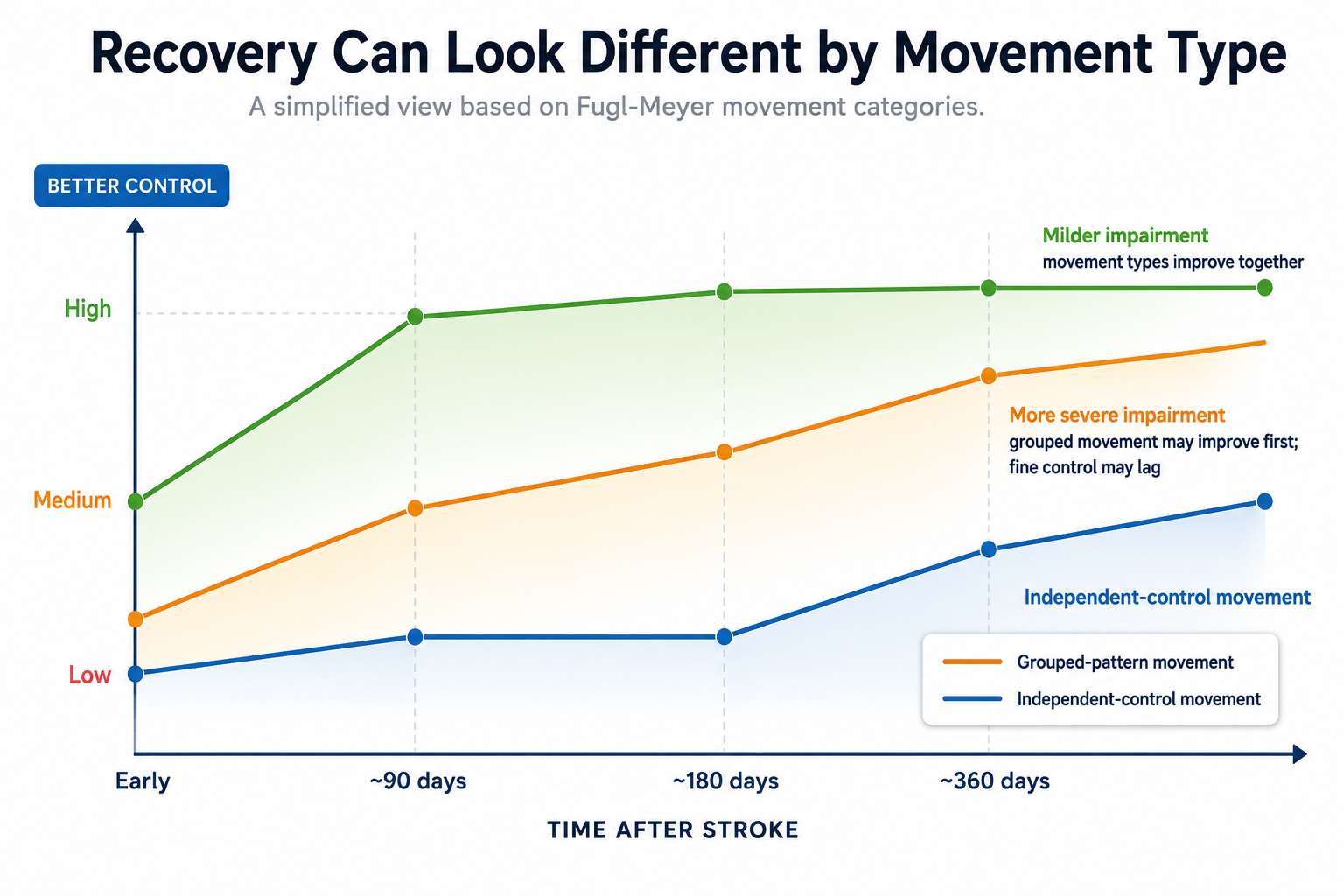
In one of my studies, we looked at different movement types after stroke. Some test items measured movements that stay inside the usual post-stroke pattern. Other test items measured movements that break away from that pattern. The harder, more independent movements were closely related to better arm and hand control.
A simple way to explain this is this:
The brain has a main pathway that helps with fine, separate control of the hand and arm. When that pathway is still strong enough after stroke, people are more likely to recover better hand and arm function.
But when that main pathway is badly damaged, the body may rely more on backup pathways. These backup pathways can help produce bigger movements, but they often activate many muscles together. That may explain why the arm moves in a stiff or grouped pattern.
This means a patient may improve in one way but still struggle in another way.
For example, a patient may become better at lifting the arm. That is progress. But if the fingers still cannot open, or if the elbow and shoulder always move together, then fine control is still limited.
That is why movement type matters.
In another study, we found that arm and leg movement patterns were strongly related early after stroke. This suggests that after stroke, the body may use broad movement patterns across different limbs. But later, around one year after stroke, some of these relationships became weaker. This may mean that the nervous system becomes more flexible over time in some people.
For rehabilitation, the message is clear:
Do not only count how much movement happens. Look at what kind of movement happens.
A big movement is not always better than a small controlled movement.
A patient may need to practice movements that gently move away from the stiff pattern. These may include:
opening the fingers,
separating wrist movement from elbow movement,
reaching without excessive shoulder tightening,
and practicing slow, controlled hand movement.
These movements may be difficult. Progress may be slow. But they may be closer to the kind of recovery that really matters in daily life.
The goal is not just to move the arm.
The goal is to regain control.
This is why future stroke rehabilitation should measure movement more carefully. We should know whether a person is moving inside a fixed pattern or gradually learning to move outside of it.
That is also why home-based digital assessment and AI-based movement analysis can be helpful. They may help patients and clinicians see small but meaningful changes that are difficult to notice with the eye alone.
Every movement matters.
But the type of movement matters even more.